
Marketing operations
Marketing operations and automation consulting
Stop doing the work your tools could be doing.
I'm a marketing operations consultant for small B2B teams, startups, and agencies running on HubSpot, Salesforce, or a patchwork of tools. I clean up CRM data, set up lead routing and lifecycle stages, and automate the follow-up and handoffs your team still does manually, then hand everything over with documentation.
When this helps
Start with the problem, not another tool.
I review the current setup before recommending software, channels, or a larger build.
You retype the same lead details into two or three tools
New leads sit unassigned until someone notices them
Follow-up only happens when someone remembers it
Marketing and sales disagree on what counts as a qualified lead
Handoffs between marketing, sales, and delivery drop things
Nobody is sure which CRM record is the current one
What a marketing operations consultant does
A marketing operations consultant designs and fixes the systems behind your marketing: how leads enter the CRM, how they are scored, routed, and staged, which follow-up runs automatically, and how results are reported. The goal is a lead process that runs the same way every time.
My marketing operations consulting is hands-on: the person who scopes the work is the person who builds it.
What an engagement can cover
These five areas depend on each other, so the order matters: clean data first, then shared definitions, then routing and automation.
CRM structure and data cleanup
I review properties, duplicates, required fields, and lead source tracking, then fix the structure so reports can be trusted. Naming conventions and merge rules keep the mess from returning. If you are moving to a new CRM, the same review becomes the field map for the implementation or migration, so old problems are not carried into the new system. The CRM audit checklist shows what I check.
MQL definitions and lifecycle stages
Marketing and sales agree in writing what makes a lead marketing-qualified or sales-qualified. I turn those definitions into lifecycle stages, required fields, and automation that moves records forward. If the teams use the terms differently, start with MQL vs SQL.
| Stage | Example entry rule | Owner |
|---|---|---|
| Lead | Submitted a form with a business email | Marketing |
| MQL | Fits the target profile and requested a demo or pricing | Marketing |
| SQL | Sales confirmed need and timing on a first call | Sales |
| Opportunity | Deal created with an amount and close date | Sales |
Lead routing and lead scoring
Routing decides who owns a new lead, by territory, company size, product line, or round robin, with a fallback owner so nothing sits unassigned. Scoring ranks leads by fit and engagement so sales sees the best ones first. The score threshold for an MQL should match the definition agreed in the previous step. The guide on how to set up lead routing covers the rule design.
Marketing automation: nurture and follow-up
I build the follow-up that should not depend on memory: new-lead alerts, nurture by lifecycle stage, re-engagement for stalled leads, and tasks when a lead goes quiet. Each workflow has enrollment and exit rules, so nobody gets an email that no longer applies.
Handoffs from marketing to sales and delivery
A handoff works when the next person gets the record, the context, and a task at once. The contract generation automation case study shows this at the sales-to-delivery step: CRM data flows through Make into the appropriate contract documents, 25 contract templates were standardized for automation, missing information is flagged for review, and the team keeps final approval.
Where marketing ops fits inside revenue operations
Revenue operations (RevOps) puts marketing, sales, and delivery on shared definitions, data, and reporting. Marketing ops is the first link: if lead data, stages, and routing are unreliable, every pipeline number downstream is too. If you are looking for a RevOps consultant, the table shows which parts of revenue operations consulting I cover. Once the records are reliable, I can build marketing reporting automation that puts the pipeline numbers in one report.
| Area | What it covers | Included here |
|---|---|---|
| Marketing operations | Lead capture, CRM data, scoring, lifecycle stages, nurture | Yes |
| Marketing-to-sales handoff | MQL and SQL definitions, routing, owner alerts | Yes |
| Sales operations | Pipeline stages, deal fields, sales reporting | Pipeline structure and reporting only |
| Sales-to-delivery handoff | Contracts, project setup, onboarding tasks | Yes, as workflow automation |
Tools I work in: HubSpot, Salesforce, Airtable, Make, Zapier
- HubSpot: properties, lifecycle stages, workflows, scoring, and cleanup. Deeper platform work sits under HubSpot implementation and cleanup.
- Salesforce: lead and contact structure, assignment, and the sync with your marketing platform.
- Airtable: lightweight operational databases when a full CRM is more than you need.
- Make and Zapier: connecting forms, CRM, documents, and team chat. See Make and Zapier workflow automation.
- Power BI, Tableau, Excel, and SQL: reporting once the records underneath are reliable.
Overflow and white-label support for agencies
If you run an agency, I can take on marketing ops work for your clients when your team is at capacity or has no CRM specialist. You keep the client relationship, and I write documentation your team can hand over under your own brand.
Process
How it works
Step 1
Map the workflow
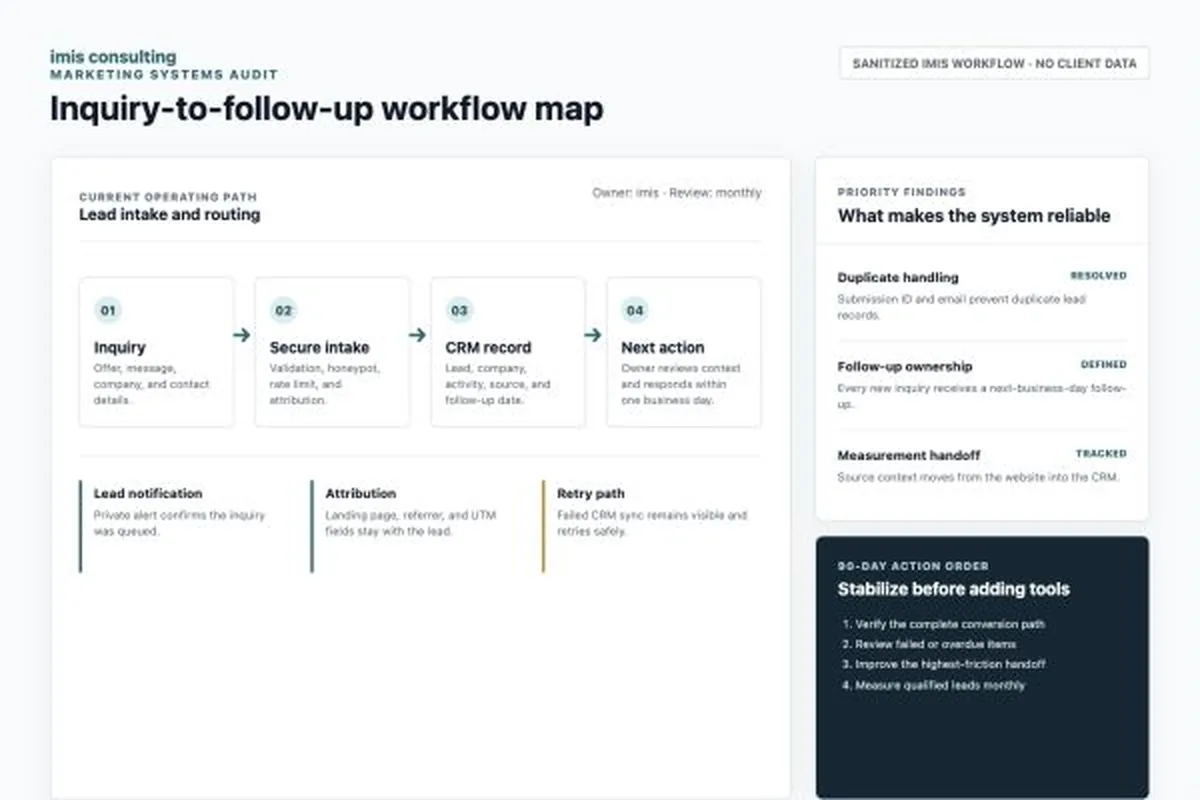
I trace the path a lead takes from form to CRM, owner, follow-up, and handoff, and mark each step someone does by hand.
Step 2
Automate the biggest gap
I build the fix that removes the most repeated work first, in the tools you already have.
Step 3
Hand it over documented
The workflow runs on its own, your team gets documentation it can follow, and you get a short list of what to fix next, in order.
What you receive
An outcome your team can actually use.
When an engagement ends, you have working changes in your CRM and automation tools, written rules for every stage or route that changed, and a plain-English map of how leads move from first touch to handoff.
Tell me the process that makes you think there has to be an easier way: the manual follow-up, the messy CRM, the handoff that keeps breaking. That is where I start.
Scope boundaries
What this does not include.
Clear exclusions protect the timeline and make a useful follow-on recommendation possible when the evidence supports one.
- An open-ended CRM rebuild with no finish line
- Replacing tools you already pay for without a clear reason
- Sales compensation plans, quota setting, or sales forecasting
- Paid media buying or ad account management
- Automation that sends, deletes, signs, or publishes without safeguards
Questions
Questions before you start
Next step
Bring one workflow to a 20-minute call
Show me how leads move through your tools today and where they stall. I will tell you whether a scoped project makes sense.
Book a 20-minute marketing ops call